Can Statins Reduce Heart Risk? – Cardiac News Round-Up

Statins

Statins are a big question in cardiac care.

Kaiser Permanente proudly reported last week the increased adoption of their daily statin regimen, but is the increased use of statins positive or negative?

Kaiser Permanente "ALL" quality improvement protocol increased prescription of heart and stroke risk medication regimen by 40 percent in community health centers. (Medical News Today, June 11)

The medication regimen bundles two generic drugs - a cholesterol-lowering statin and a blood pressure-lowering drug in daily doses to patients with diabetes or heart disease.

In 2009, Kaiser Permanente released a study showing that their protocol lowers the chance of hospitalization for heart attack or stroke the following year by more than 60 percent.

Statin association with memory loss in question? (MedPage Today, June 8)

Continue reading Can Statins Reduce Heart Risk? – Cardiac News Round-Up

Simple Test After Heart Attack Predicts Heart Failure

heartattackThe University of Glasgow presented research at the British Cardiovascular Society's annual conference, yesterday that proves a pressure- and temperature-sensitive wire inserted into a coronary artery after a heart attack can predict heart failure.

The standard assessment, a coronary angiogram, "can only identify narrowed vessels and cannot tell the doctor if, or how much, heart blood vessel damage has occurred," writes Medical News Today. Using the wire, the level of damage to arteries after a heart attack can be assessed in minutes -- a key indicator of high risk for heart failure.

The new assessment could lead to quicker treatment of patients at greatest risk for heart failure and improve outcomes.

5 Essential Characteristics of Highly Effective Cardiovascular Teams #1 – Communication

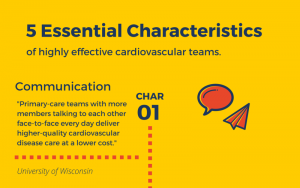
char01In March, researchers from the University of Wisconsin School of Medicine and Public Health released a report detailing the importance of communication in cardiovascular care.

The report was straightforward: "Primary-care teams with more members talking to each other face-to-face every day deliver higher-quality cardiovascular disease (CVD) care at a lower cost."

Continue reading 5 Essential Characteristics of Highly Effective Cardiovascular Teams #1 – Communication

Team-Based Care Isn’t Controversial


The Future of Nursing, in particular, has created considerable controversy regarding whether APRNs should be licensed to practice independently in primary care settings. The hot-button issues that are part of that controversy, such as practice independence, competition, and restraint of trade, are not germane to the present discussion on cardiovascular team-based care. Issues that are germane to cardiovascular team-based care, such as interdependency, cooperation, autonomy, efficiency, and effectiveness, however, are not controversial. (read the 2015 ACC Health Policy Statement on Cardiovascular Team-Based Care)

The Institute of Medicine, in collaboration with the Robert Wood Johnson Foundation, published a report entitled The Future of Nursing: Leading Change, Advancing Health in 2010, which the ACC's Health Policy Statement mentions as generating "considerable controversy between nursing organizations and physician organizations."

TEAM-BASED CARE ISN't CONTROVERSIALThe statement suggests that arguments over practice independence have no relevance to the well-substantiated argument in favor team-based care, but it's easy to see how those lines get blurred. Professionals feel threatened when scope-of-practice barriers are taken down for professionals with a different educational knowledge-base.

The issue? These fears can be very influential in maintaining state regulatory barriers to team-based care.

Continue reading Team-Based Care Isn’t Controversial